
I've Been Busy...
Links on links & a Q&A with Runher editor in chief and founder, Ashley Mateo
This week’s missive is a little different from the usual format and timing because I’ve been busy! A few different collaborations with other newsletters, print publications, and events dropped this week (I told you we were leaving modesty in 2025!) What follows is a round-up of some of those pieces, plus a few favorite reads from this week so far, and a conversation with Ashley Mateo, the founder of Runher Magazine.
Next week, we’ll be back to regular programming with a look at what’s up at the Australian Open in conversation with Hard Court.
Here’s what I’ve been up to…
Perhaps the biggest Sweat Lookbook feature ever? I’m this week’s Monday Media Diet over at Why is this interesting?! Read on for a detailed list of everything I read and listen to, with some thoughts on swimming holes, Boston Irish Catholics, and my female protagonist policy.
I teamed up with the great Lindsay Sword of Fashion Soup on a deep dive into ski style for her Sunday send. Featuring all my favorite lady-led ski brands, plus a few historical tangents to explore how women created the market for ski fashion!
I got to see an advanced screening of Learning to Fly and hosted a Q&A with Aisha McAdams, the subject of the film and the uber-talented photographer behind all your favorite running shots. She is also a very talented and ambitious runner, too. This movie made me laugh and cry. Watch this space!
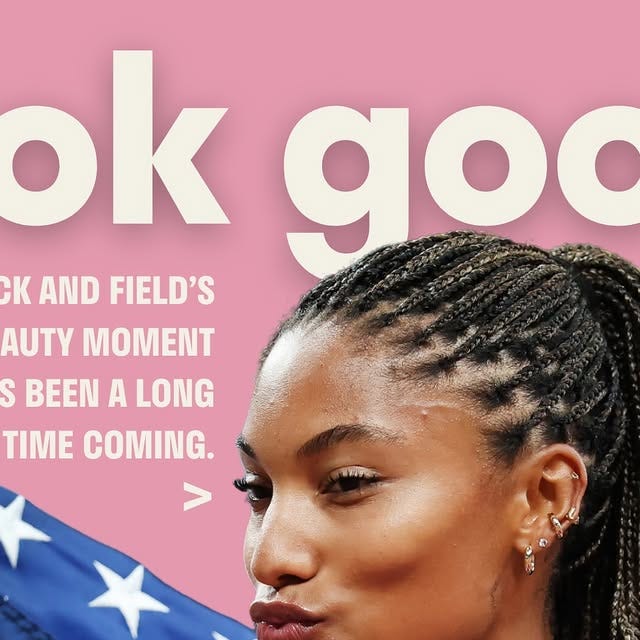
My beauty story in Issue 02 of Runher is out! This was a serious labor of love, in which I got to dust off my historian hat and speak to some incredible women, including Tara Davis-Woodhall, Gabby Thomas, Samirah Moody, and Shannon Rowbury. You’ll need to subscribe to Runher to read it, but their social has a good summary here.


What I’m Reading
I had an unrequited crush on Foster Huntington when he lived in NYC in 2012, so I enjoyed this examination of Patagonia’s so-called sustainable business on many levels!
Let the Olympic fashion content begin!


I can barely wrap my head around everything happening at Paris Men’s Fashion Week, but thankfully Ariana Ferwerda and Cole Townsend have the rundown.


Click through for good vintage workout wear! I’m finishing a story on trends in running and speaking to a lot of designers who referenced the rise of vintage in activewear. It’s crazy how much everyone is talking about this topic now. We went from 0-100 very quickly.

The Road is My Runway
In conversation with Ruhher founder, Ashley Mateo
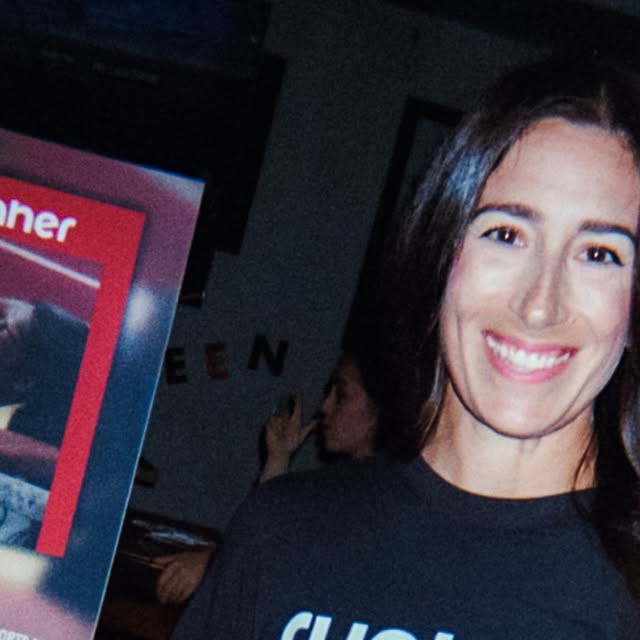
I’ve known Ashley since my early days in the running industry. Back then, she wrote for places like Redbook and Cosmo, and I pitched her Tracksmith product stories and stamped her marathon poster at our pop-ups. Back in early 2025, she called me to share her idea for Runher before the crowdfunding campaign went live. We chatted about how to get folks sharing it, and I told her: “People are going to be jazzed about this and want to support.” Lo and behold, the campaign took off and easily doubled their fundraising target. Today, Runher is not only helping lead the conversation in the sport around women, trans and nonbinary athletes, it’s also reimagining what a running publication can look and feel like. I was psyched to sit down with her to learn more about her vision.
Lee: The first question I always ask when I talk to people is: how did you get into sports? And do you remember what you wore?
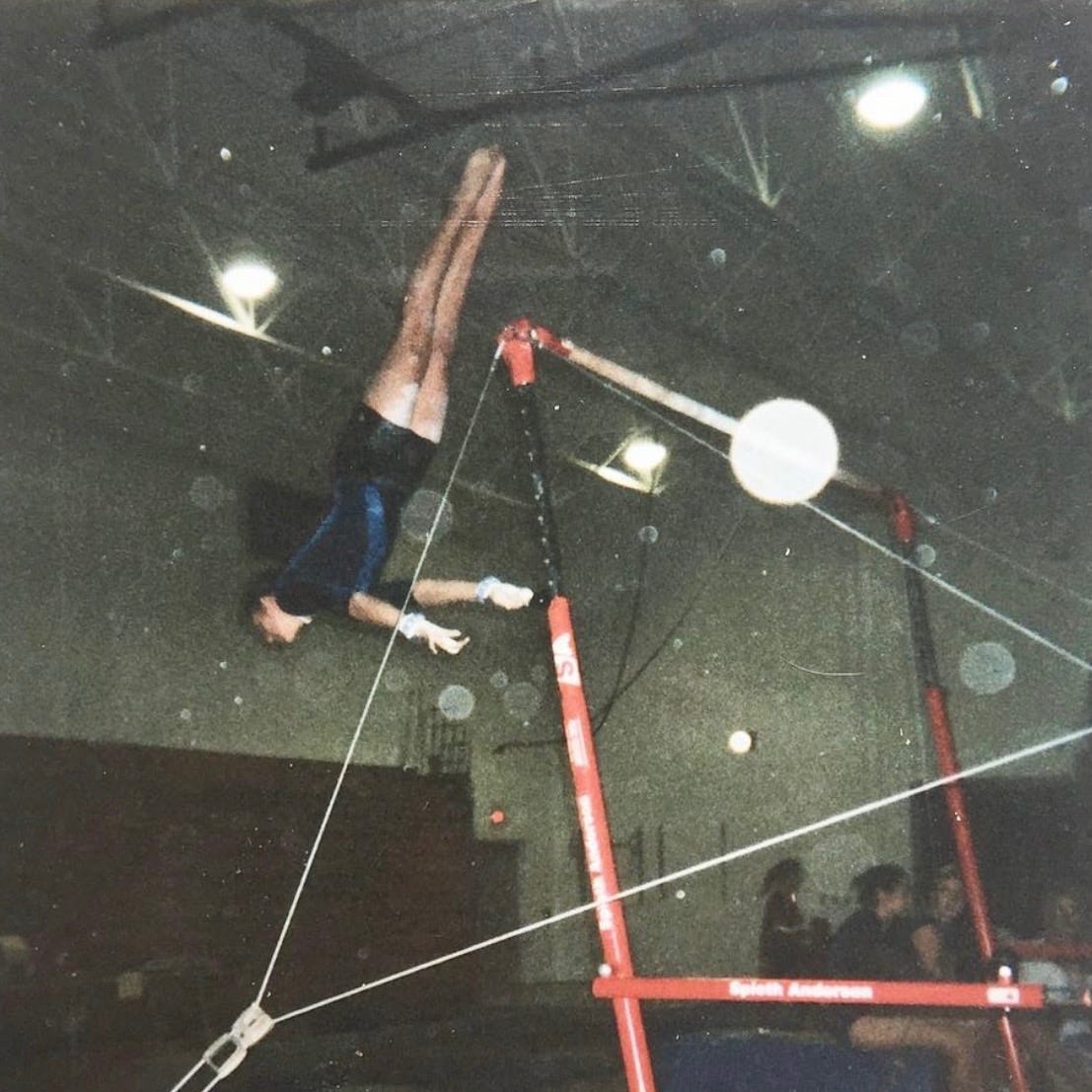
Ashley: Oh, I can’t forget what I wore. I was a gymnast from about two years old until college, and that was probably the most defining physical experience of my life. I did roughly three hours of gymnastics every day after school during my formative years, so I was in a leotard more than I was in regular clothes.
I still have some of those leotards. Crushed velvet—what an era. For practice, we had tank leotards, and for competition, we had long-sleeve ones. Some of them were epic: rhinestones, sheer panels, velvet—really fun fashion moments.
Lee: Do you think being in a sport where presentation is part of it shaped how you think about getting dressed for running?
Ashley: That’s a good question. I actually don’t think gymnastics encouraged self-expression at that time. In competition, everyone wore the same leotard. You could wear whatever you wanted in practice, but leotards are expensive, so I rotated through a few.
Competition was very rigid—especially in the late ’90s and early 2000s. What we see in gymnastics now, with expressive makeup and hair, just didn’t exist then. You could be penalized if your bra strap showed or your hair wasn’t perfect. Everything had to be slicked back and controlled.
I don’t think I consciously thought about self-expression then, but I do believe self-expression is a big part of why running is fun for me now. My thing has always been sunglasses. I don’t want people to see my face when I run—if you saw my eyes, you’d know how much I was suffering. Sunglasses became a way to hide that while also having fun with big shield lenses, mirrored colors, reflective finishes.
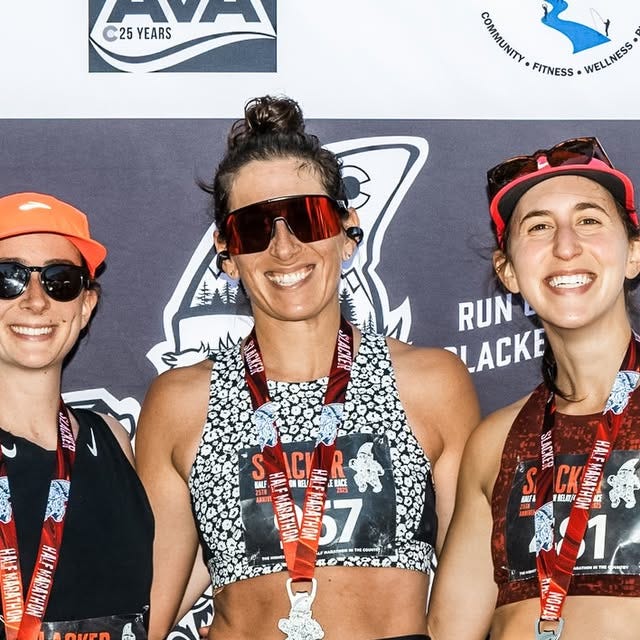
I really believe that if you look good and feel good, you’re going to run better. Even in training, I coordinate my outfits. If I’m wearing blue shorts and a blue sports bra, I’ll pick bluer shoes and sunglasses to match. I want it to feel like an outfit. I’m in workout clothes so often—why wouldn’t I have fun with them?
Lee: I’ve been thinking a lot about how fashion in running has evolved. I tend to connect it to the rise of the super shoe—price sensitivity eroding for better or worse, new silhouettes changing how runners dress. From your perspective, how have you seen that shift happen?
Ashley: I think a lot of it is post-COVID—maybe the third running boom at this point. What stands out to me is how community-driven this wave has been. The social side of running has exploded, and fashion plays into that. Apparel becomes a way to identify yourself, to send a message.
There are so many brands now, and I don’t know which came first—the chicken or the egg—but you can align yourself with one and say, “This is who I am.” Maybe you’re an edgy, urban runner who wears Bandit. Maybe you’re a fast, preppy runner who gravitates toward Tracksmith. Those are just examples, but fashion has become a way to find your tribe.
You can show up at a race and immediately feel a sense of connection: I probably identify with that person—they’re wearing what I wear. I wrote a story for The Wall Street Journal about boutique running brands building these incredibly loyal fan bases, and part of that is because they speak to people beyond performance.
Running brands used to market almost exclusively around speed and efficiency. Now they’re appealing to identity—former skateboarders who run and like Satisfy, or people who see themselves reflected in a certain aesthetic or philosophy. It’s no longer just I run, so I wear this brand; it’s I run, and I’m this kind of person, so I wear this brand.
I haven’t found one that speaks to my gymnastics sensibilities yet—and I don’t think we need rhinestones on running gear—but you know what I mean.
Lee: I love that. It feels like a good segue into Runhher. The opportunity there feels very community-driven and identity-driven, especially centering women, trans, and non-binary runners. Can you talk about how Runher started and how it fits into this moment in running?
Ashley: People always ask who Runher is for, and I say “everybody,” which is obviously not a great demographic answer. But it really is meant to speak to women—and everyone else—at all levels of the sport.
The three pillars are community, culture, and competition. Yes, we cover elite athletes, but we also cover people driving change at the grassroots level and the broader community around the sport. The goal is to go deeper in those three areas and, in doing so, connect with as many people as possible.
The mission is that Runher is for her—and for everyone who supports her. It’s not “for women, by women.” Women already know women’s running is great. Women are driving this boom. What I want is to give female runners a space that truly belongs to them, while also welcoming anyone who wants to understand and support women’s running better—whether at the elite or participation level.
It’s broad, but it’s really for anyone who wants to invest more—time, energy, and yes, money—into women’s running.
Lee: That makes sense, especially since publications centered on men’s sports have always expected women to engage with them.
Ashley: Exactly. Women’s brands and publications often have to work harder to be taken seriously. There’s a perception that if it’s for women, it’s somehow less rigorous or less researched. With Runher, I wanted to create a space that hadn’t existed in print in the U.S. for a while—a space dedicated to women in running.
That can take many forms, but women will always come first. My hope is that the stories we publish become conversation starters, maybe even game-changers within the industry. That’s a lofty goal, but we’ll see where it leads.
Lee: I was talking recently with the founder of HETTAS about how much we still don’t know about women’s physiology in sport. It’s crazy!
Ashley: Totally. There are so many questions we don’t even know to ask yet. We ran a great piece by Zoe Roem in the first issue about the science gap in women’s sports. Christine Yu literally wrote a book on this.
There’s nothing wrong with male-first publications; I used to read GQ and Esquire. They had great journalism. What I want Runher to be is a publication with excellent reporting that centers the female experience—because we don’t have many outlets doing that right now.
Lee: And women’s races are just as compelling, if not more, than men’s.
Ashley: Exactly. The issue isn’t interest—it’s access and storytelling. Fans are there. Participants are there. But you have to give people a platform to engage. Put the races on TV. Tell the stories. Once people are invested, everything else follows—viewership, merch, sponsorship.
In running, coverage often misses those opportunities. If broadcasts don’t give women equal airtime or context, people don’t get invested in the athletes, and then they assume there’s no interest. That’s just not true. We need better storytelling.
Lee: I’d love to talk about the process of making Runher. What surprised you?
Ashley: Honestly? Everything except the writing and editing—that part was easy for me. Everything else was a crash course: working with printers, designing pages, marketing, social media. At Condé Nast or Hearst, you have entire departments for that. At Runher, we had four people.
Producing a 140-page print magazine on a lean team was overwhelming at times, but I’m incredibly proud of what we accomplished. Looking back at my early print days, the luxury of a fact-checking department feels wild now. But for a first issue, I think we did something really special.
Lee: It feels like something you want to keep.
Ashley: That’s exactly the goal. Print asks you to slow down. I don’t want people reading these stories online. I want them to feel the paper, sit with the images, immerse themselves. There’s no shortcut.
We’re so burned out on screens. Running itself is an escape from that. Print can be, too. I hope people pick up Runner, read one story, put it down, think about it—and come back to it later.
Lee: Finally—what’s next?
Ashley: We’re deep into Issue 3 right now, and I’m excited about how the pitches are evolving as people understand what we’re doing. I’m also excited about bringing Runner off the page—events, race weekends, showing up in real life. We were at the New York Marathon and other events, and we’re already thinking ahead to 2026.
The magazine is the gateway, but the goal is to amplify women’s voices everywhere—on paper and in person.
Subscribe to Runher, here.
You've been BUSY! We love to see it :)
THANK YOU for introducing me to Foster, I've always wondered what REALLY goes on at Patagonia. And thank you for including me among such wonderful company!