


This week, Rapha CEO Fran Millar announced her resignation after “two brilliant and bonkers years” at the brand, setting my LinkedIn feed ablaze in hot takes from men bemoaning Rapha’s demise. Amidst the grandstanding, I failed to see anyone addressing the obvious: the glass cliff has claimed another victim.
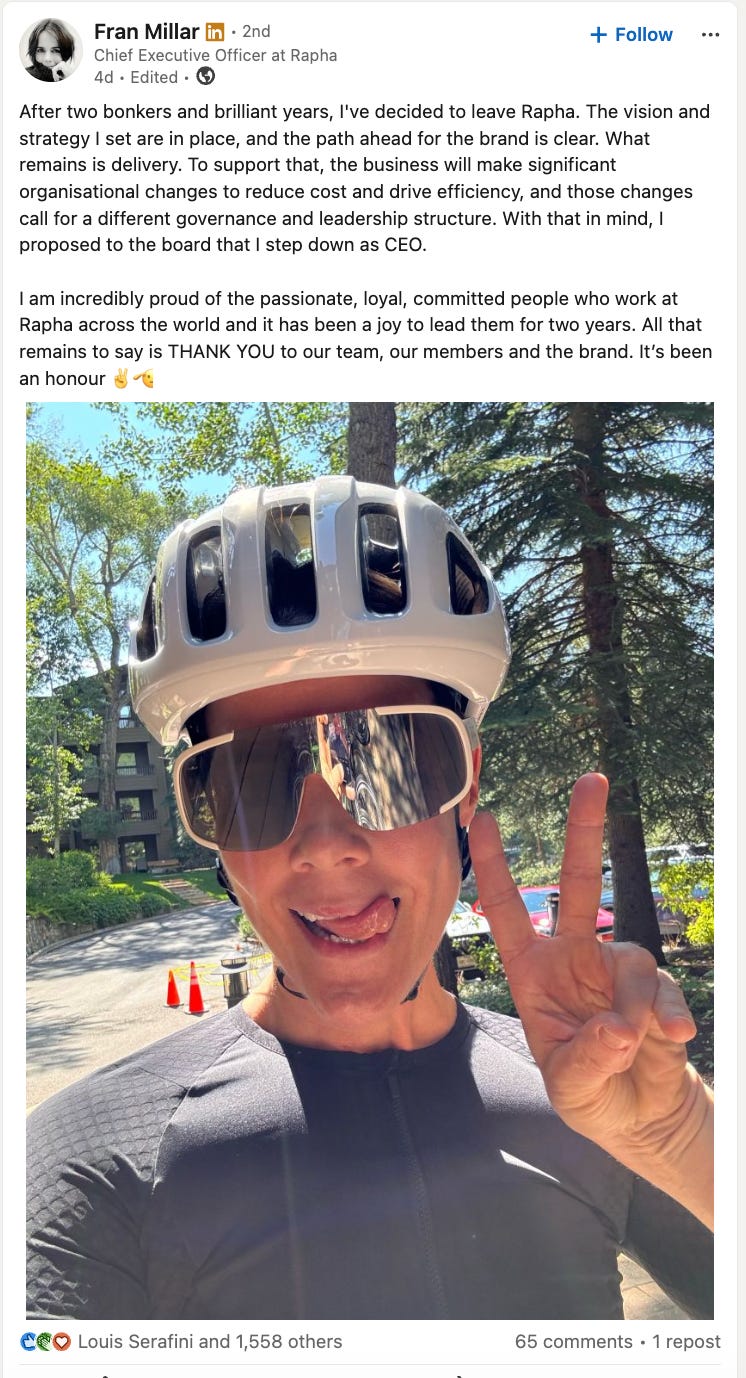
Millar was Rapha’s first female CEO and one of the very few women leading a global cycling brand. I counted the rest on one hand: Giant Group’s Phoebe Liu, HED Cycling’s Anne Hed, and Strider’s Dona Nesselhuf. There are a host of boutique women-led cycling brands like Samsara, LUCA, Jelenew, and Pepermint (to name just a few). But, when it comes to the brands driving cycling culture? Well, it’s a sea of (white) men. Millar’s resignation continues the long tradition of women drinking from the poisoned cup of leadership. Handed the reins of companies in crisis, they’re set up to fail.
It’s hard not to see the appointment of Heidi O'Neill at Lululemon as yet another case of a woman leader on the brink. While O’Neill is not the first woman to take the helm at Lululemon, she arrives at a brand that’s lost its edge. Earlier this month, she wrote in her introductory email:
“Re-accelerating growth will require focus, urgency, and action. We have work to do. We know the last year has been hard, and I’m not going to pretend otherwise. But what matters now is how we respond and what we do next. We need to challenge ourselves, evolve how we work, and hold ourselves to a higher standard. Some choices will be difficult, and I will always do what I believe is right for the organization and our community.
The challenges we face did not emerge overnight, and they will not be fixed overnight — but I am confident they can be fixed.”
I was rooting for Millar, and I’m rooting for O’Neill. But it’s hard not to feel downbeat about the state of women leaders in the outdoors. If they can’t succeed, who can?
Whatever the industry, whoever the founder, building an apparel or accessories brand is not for the faint of heart. A cash-intensive business model, it takes discipline and grit to succeed. And no small amount of luck.
I was meant to dive deeper into this topic this week with a trip out to Title Nine’s ninth-annual T9 Pitchest in Emmerville, CA. But Mother Nature had other plans, and instead of connecting with a host of women-founders in person, I watched the events from afar.
If you’re unfamiliar, T9 Pitchfest is an entrepreneurship competition and mentorship event aimed at accelerating women-owned businesses in the outdoor industry. At a time when funding for female entrepreneurs is scarce – in 2025, U.S. startups with all-female founding teams secured just 1.1% of total venture capital dollars, down from 2.1% in 2024, according to Pitchbook data– Title Nine stands apart, investing nearly $75 million into women-led brands and helping founders scale their business. Pitchfest winners receive a one-year purchase order from Title Nine, along with marketing support and hands-on mentorship.
“It’s given me an epic support network,” says Emily LaPlume, CEO and founder of Saturday Swimwear (Pitchfest 2025). “Not sure how UPCs work? Call Mel. Need to vent about manufacturing issues? Message Jen. Having a group of women who’ve been there, and who are genuinely happy to share what they’ve learned, is priceless when you’re figuring things out as you go.”
The business upside can be significant: participating brands have reported triple- and quadruple-digit sales increases across their own platforms and through Title Nine’s site and stores. Companies that have come through Pitchfest include many of the same folks we’ve covered here on The Sweat Lookbook, including SENIQ (Pitchfest 2024) and Wild Rye (Pitchfest 2018), among others.
Of course, not every brand that comes through Pitchfest successfully scales. While clicking on previous winners, I spotted that Luxxefit (Pitchfest 2025) and Tought Cutie (Pitchfest 2021) have taken down their websites. Both brands were Black-owned – a grim testament to the challenges facing Black women entrepreneurs. According to a 2026 report by Wells Fargo consulting firm Ventureneer, while the number of Black women-owned businesses rose about 13% last year, their share of venture-capital funding was less than .3%, the lowest in a decade (per Crunchbase.)
Wild Rye founder Cassie Abel has been open about her 10-year old brand’s ups and downs, sharing earlier this year that she had to let several team members go. “Our expenses and headcount had outpaced our top-line growth, and we needed to realign the business around a clear path to profitability,” she wrote on LinkedIn. “Building a healthy, sustainable business sometimes requires making difficult choices today to ensure there’s a stronger company tomorrow.”
Still, Title Nine’s story provides a blueprint for what a women-led company can achieve in the outdoor industry with the right combination of grit and luck. Founded in 1989 by Missy Park, the brand bootstrapped its way to 300 employees, 17 stores, and a $100 million business.
Building The Girls Club
Given Title Nine’s success, it’s not surprising to learn that the mood at Pitchfest is relentlessly upbeat. Grounded in Boston, I ask San Francisco local and outdoor brand nerd Katherine Britt to hit up Pitchfest in my stead. “The general vibe was high energy, supportive, and fun,” Britt tells me, “It felt like a space of radical optimism, which matched the idea of the event elevating women entrepreneurs to ‘lead, risk and own in the outdoors industry.’ There was a deep warmth that felt very different and refreshing from the tech pitchfests I’ve attended in previous eras.”
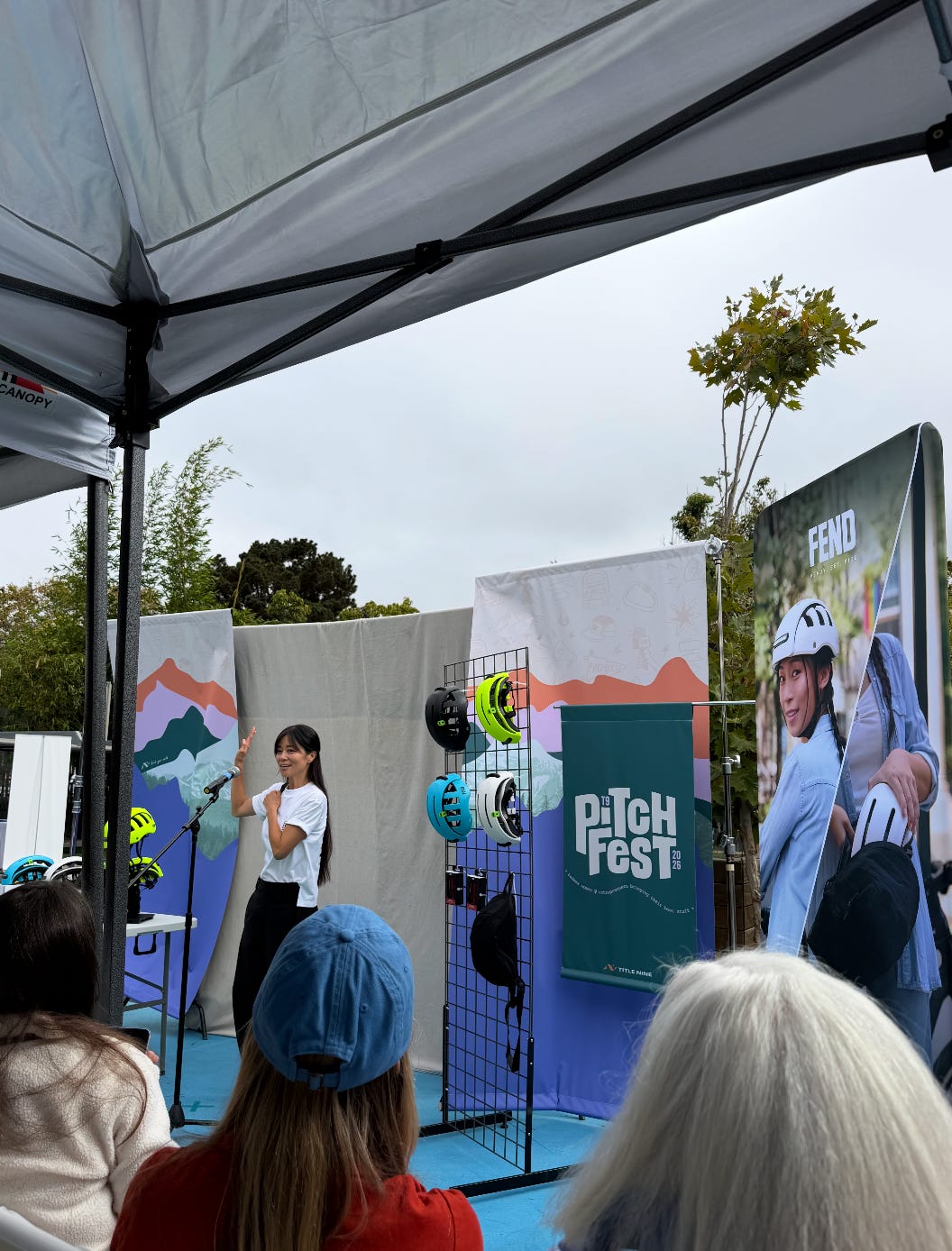
It’s a sentiment the participants echo. ”I never knew business could feel like a team sport until I met the peeps @TitleNine,” wrote Tobiq Travel founder Mel Fransden (Pitchfest 2026) in a post, “They showed me what happens when women share the playbook, open doors for each other, pass the ball, and genuinely want you to win.”
In 2020, the skiwear brand Halfdays launched with the take-no-prisoners motto: “Bye Bye, Boys Club.” While their rallying cry was meant to combat gatekeeping on the slopes, it feels of-a-kind with Pitchfest’s vision. To win in the outdoors, women need a Girls Club of their own.
Mentorship and community are an essential part of the Pitchfest equation, not only because they are vital to any brand’s success, but also because leaders like Title Nine’s Missy Park are crystal clear that “Capital isn’t the problem.” Fundraising is only one part of the equation for building a successful brand. The Pitchfest prize underscores this: winners get a purchase order from Title Nine. It’s an opportunity and a platform, not a fundraising round.
For the participants, Pitchfest’s steely-eyed clarity is invigorating. “Women have a hard time talking about money like this,” Natasha Woodworth, founder of Curious Creatures (Pitchfest 2026), tells Britt, “Like it’s not classy or it’s frowned upon to say: I want to scale a business. I want to make money.”
If you can’t be brazen at T9 Pitchfest, well, then where can you? As Saturday Swimwear’s founder LaPlume notes, “This is the safest place you’ll ever find to get comfortable with the uncomfortable.”
In a world that offers women leaders either glass cliffs or bootstraps, Title Nine’s efforts serve as a reminder that we can climb much higher when we’ve got each other’s backs.
Many thanks to Katherine Britt for contributing to this piece from Pitchfest. Follow her work at Stride and Form.
Also, catch me on NPR Marketplace, speaking (briefly) about the history of running booms and style!
Such a stellar day! Was so energized by all the amazing pitches + the community of women at this year's T9 Pitchfest